ViVA020Bleach A.6 - Aqua Timez - Alones.mp3 |
||||
Based on the previous generation Daihatsu Mira which has only just been replaced last year, it’s really no secret how the Viva looks like. It was shown at the KLIMS as the Perodua XX06 Concept fully undisguised for everyone to see, albeit having no doors. Inheriting Daihatsu’s K-car expertise, the Perodua Viva shares the Myvi’s space-efficient interior engineering. In terms of interior length, the Perodua Viva is actually longer than the Perodua Myvi, at 1845mm compared to the Perodua Myvi’s 1835mm. This interior length is class leading, with all competitors including it’s own Kancil and Kelisa models having interiors shorter than 1790mm. As for interior width, it is 1300mm wide, compared to the Myvi’s 1400mm. It’s definitely wider than the Kelisa’s 1220mm and 1185mm. The Perodua Viva has a 149 liter boot capacity with the rear seats up, and this increases to 449 liters with the rear seats down. It’s four doors open 90 degrees, an improvement over even the Perodua Myvi which has an 80 degree door opening angle, and a big improvement over the Kelisa’s 60 degree door opening angle. There are many storage compartments in the car, other than the usual glovebox, there is a tray located under the passenger seat. L-R: 660 and 850cc, 1000cc, 1000cc Premium 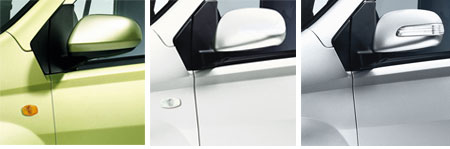 The Perodua Viva comes in four trim levels – 660cc, 850cc, 1000cc, and 1000cc premium. The Perodua Viva 660cc has trim level that is obviously for cost-saving reasons. Bumpers, door handles, and wing mirrors are material coloured – that usual grayish stuff that’s unpainted. Even the door trim has no fabric. The audio system is a radio and cassette player only, without an option for CD, and there are only front speakers. Wheels are 12 inch steel wheels. Seat covers are specified as “standard grade”, whatever that means. The side and front turn signals are amber lense units. There are no power windows. The Perodua Viva 850cc takes it up one notch with the door handles and bumpers painted to the body colour, though the door is still without fabric. Wheels are still 12 inch steel wheels, but a full wheel cap is supplied. Power windows are available. Seat cover material is specified as “medium grade”. The audio system is equipped with a CD player and also 4-speakers. It also has powered windows, which means you can adjust it’s angle from within the car through button control, but it does not have a retracting feature. Both the 660cc and 850cc have no power steering! The Perodua Viva 1000cc adds some nifty features like the under-seat tray, headlamp buzzer warning (in case you leave your car with your headlamp on), seat height adjuster, and most importantly the power steering. The wheels are still steel wheels with full wheel cap covers, but are 13 inch in size. Side and front turn signals are of the clear lens type. The premium version has the usual creature comforts such as electrically retractable side mirrors, a first for a Perodua car. Even the premium Myvi does not have this feature. Other premium feature are the height-adjustable driver’s seat and the vanity mirror on the sun visor. Of course, the features that are a must for any premium line version of a local car are ABS and dual SRS airbags, available only on the 1000cc Premium trim of the Perodua Viva. The 1000cc Premium has what Perodua calls “High Grade” seats, while the 1000cc standard uses the same medium grade seats as the 850cc. Other than the different engines, other technical specs you should take note of is the suspension system. All Perodua Viva cars use McPherson struts are the front and a torsion beam setup at the rear, but the 1000cc models have an additional stabilizer bar in front. Perodua Viva Engines
Powering the Perodua Viva is a range of three engines, which all come with DVVT Variable Valve Timing. Yes, DVVT even for the 660cc and 850cc models. The 660cc EF-VE engine is a high revver, with peak power of 47 horsepower coming in at a high 7,200rpm. The engine readline is an astronomical 8,000rpm (look at the photo of the meter panel below), numbers usually associated with performance cars, but is actually quite typical of small displacement K-car engines. Peak torque of 58Nm arrives at 4,400rpm. The 850cc engine option is the ED-VE, making slightly higher horsepower than the 660cc at 52 horsepower, however it is achieved at a lower 6,000rpm. Peak torque is also higher and arrives earlier in the rev range – 76Nm at 4,000rpm. The biggest displacement engine is the EJ-VE which we are all familiar with since the Myvi 1.0 liter – 60 horsepower at 6,000rpm and 90Nm of torque
achieved at a low 3,600rpm. All cars come with a 5-speed manual
gearbox, but the 1000cc models have 4-speed automatic gearboxes.
 viva 1000cc Premium  ViVA Elite ViVA Color 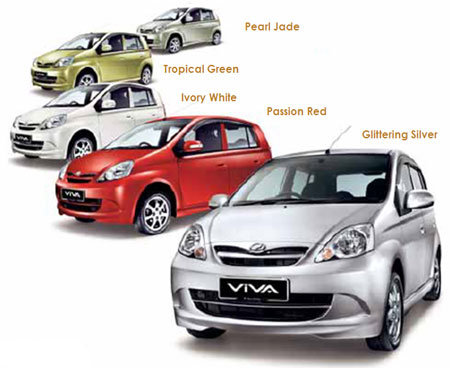 Power Interestingly, it seems that the same 1.0 liter DVVT EJ-VE engine in the Perodua Viva makes more torque than the Perodua Myvi’s 1.0 liter DVVT EJ-VE engine. The Viva claims to make 90Nm of torque at 3,600rpm, while the Myvi 1.0 liter only makes 88Nm at 3,600rpm – that’s a minor difference of only 2Nm though. Since the Perodua Viva 1.0 liter would clearly beat the Myvi 1.0 in terms of power to weight ratio, so let’s compare the Myvi 1.3 to the Viva 1.0 Premium instead. The Myvi 1.3 weighs 955kg and puts out 86 horsepower. That’s a power to weight ratio of 0.09 horsepower per kg. As for the Perodua Viva 1000cc Premium, it weighs 800kg and puts out 60 horsepower – that gives it a power to weight ratio of 0.075 horsepower per kg. So we can conclude that in a drag race, the Viva won’t be able to smoke it’s larger sibling in stock form. That doesn’t mean the Viva is terribly slow – in a previous supermini shootout done together with folks at NST Life & Times, I found that the Myvi effortlessly smoked other superminis with larger 1.5 liter engines. Another thing to point out is the Perodua Myvi 1.3 liter uses a 4-cylinder engine, and 4-cylinder engines are alot smoother than 3-cylinder engines like the one found in the Perodua Viva. 3-cylinders have more vibration, which might end up being felt by you in the steering wheel and other points in the chassis. Fuel Economy According to Perodua’s own charts, the Perodua Viva 1000cc Premium can travel 17.5km per liter of petrol on a combined cycle which I suspect involves alot of light footed driving and highway cruising. This is for the manual transmission. The Myvi 1.3 manual is rated at 17.1km per liter of petrol. Very similar fuel consumption, however the people on the streets who actually own the Myvi 1.3 manual reports actual mileage of about 13 to 14 km per liter if driven frugally. As for the auto transmission, Perodua says the Myvi 1.3 Auto can get 13.5 km per liter, however the average man on the street usually gets about 10 to 11 km per liter. Comparing it to the Viva 1.0 liter automatic, Perodua says it can get 15.1km per liter, so expect about 12km per liter in reality. Space The Perodua Viva is actually longer in the interior than the Perodua Myvi at 1845mm compared to the Perodua Myvis 1835mm, but a great margin narrower. Having a long interior is important, it ensures the rear passenger legroom is at comfortable levels, just like the Perodua Myvi’s. However, being narrower the downside is you can’t really fit 3 people in the rear bench comfortably, making the Perodua Viva more of a 4-seater than a 5-seater. The Viva’s boot is only 149 liters with the rear bench upright compared to the Myvi’s 255 liters, significantly smaller, however you can extend this size by dropping the rear passenger bench to create a 449 liter space. Ride and Handling Nothing much can be said about the Perodua Myvi’s handling abilities other than the fact that it’ll probably get you to work and back safely. From what I’ve heard from some journalists who’ve driven the car, I think I shouldn’t expect much of the Viva’s either. Which is a shame as the Kelisa was a somewhat fun drive. Many will miss the Kelisa’s zippy DNA which is reportedly missing in the new Viva. If you want a driver’s small car, go get the Proton Savvy. Equipment levels One thing I am concerned about is the lack of an integrated CD player head unit in the Perodua Viva, which means Viva owners will have to be careful about where they park their cars lest their mirrors get smashed and their head units stolen. However, this means the CD player can be easily swapped. The equipment level of the Perodua Viva 1.0 liter standard is disappointing to be honest, not even proper alloy wheels are supplied, instead you are given steel wheels. This means a difference of roughly RM4k on average gets you airbags, ABS, proper alloy wheels, wing mirrors with signal lamps, roof spoiler, and etc. I’m really not sure if it’s worth it or not – I’ll leave it up to you. The Perodua Myvi on the other hand has just about everything you need in the baseline 1.3 liter model. It also feels more premium because of an interior design that looks abit more higher grade, as well as Optitron-style meters which are self illuminating, unlike the backlit meter clusters of the Perodua Viva. Safety Both the Viva Premium and Myvi Premium have dual airbags, antilock brakes – the usual stuff. The Perodua Myvi’s Japanese cousin the 2005 Daihatsu Sirion scored a 4 star score in the Euro NCAP crash test for adult protection, while crash test results of the previous gen Daihatsu Mira that the Perodua Viva is based managed a 3 star rating.
When buying a new car in Malaysia, a few things to consider : Firstly, decide on how much can you allocate for it including 1) the cost of insurance, Shop around. check out what is hot in the market. For 2009, Best Model of the Year was Proton Saga and Best Value-for-Money Model of the Year was Perodua Viva, though the best selling model was lead by Perodua Myvi from the year of 2006. In units sold in 2009, Proton Saga was in second place followed by Perodua Viva and Proton Persona. Meanwhile, Toyota Vios in fifth place lead the list for imported cars followed by Honda City, Toyota Hilux and Nissan Grand Livina. Honda City was best model of the year in Thailand. Best selling model in the world. Local cars are better for those who earn less than RM5k monthly, be it a Perodua or a Proton, check your local car dealer for the best bargain. Some car dealers has better offers than the others although the loan calculator is the same for new car. Car dealers sometimes offer discounts.
 ViVA GALLERY Viva Slideshow: Skeito’s trip from Petaling Jaya, Selangor, Malaysia to was created by TripAdvisor. See another Malaysia slideshow. Create your own stunning slideshow with our free photo slideshow maker. |
||||

This free website was made using Yola.
No HTML skills required. Build your website in minutes.
Go to www.yola.com and sign up today!
Make a free website with Yola
